Boom and Bust: How have individuals, government policy, technology, and belief systems contributed to the nation's agricultural & industrial development?
Student: Karl Truong

The 1920s, famously named as the "roaring 20s", was a time where the riches and wealth from the high classes of society trickled down to the middle class. The reason for this was because of new inventions, new ideas, and "buying on the margin". "Buying on the margin", or credit as it is called now, is relatively a new idea. People who bought stocks mainly used loans to pay for the price and hopefully in return sell those stocks at a higher price in order to compensate the debt. A new device, called the radio, was a new way to listen to music and the news. These revolutionary products spread out like wild fire. Despite the U.S. having its highs, its lows came a decade later.
The 1920s has its highs, but in reality its cons outweighs the pros. The "roaring 20s" was a time where people were careless about their actions. As stated before, buying with credit was a new way to buy and spend. Since there were stocks that were worth more than they actually were, people mainly bought with credit and sold them at a higher price. As a result, when the stock market crashed in 1929, the stocks were practically worthless, leaving the investors and consumers in debt.
 |
| A run on the bank scene from It's a Wonderful Life |
Another major problem during the 1920s was the over-saturation of products on the market. The "roaring 20s" was a time of consumerism. Since people had an excessive amount of cash, manufacturing products can increase. Take the radio for example. It was popularized in the 1920s and mass produced and it was made for cheap, due to new manufacturing methods. However, with other people that wants to cash in on this once in a life time opportunity, rivaling companies started to appear and mass produce the same product under a different name. This is called an over-saturation in the market. Since more and more of the same product is massed produced by different companies, no one wanted to buy more radios. Consequently, this made a lot of companies lose more money than what they can actually gain. This concept can also be found roughly 20 years ago.
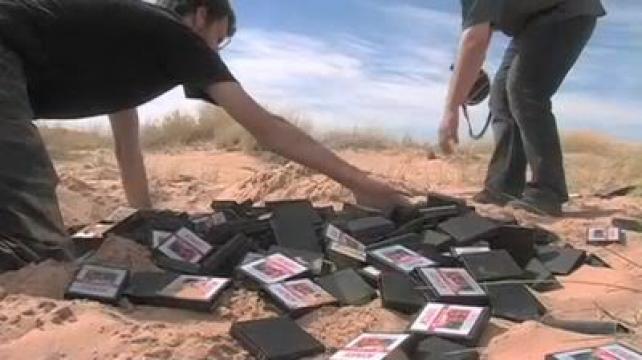 |
| Atari Cartridges that were buried due to the over-saturated market |

....I probably side-tracked a little bit, bite me.
Finally, I want to cover one more main problem. That is farming. And I know what you're thinking, "But isn't farming for the good of America?" Well.... yes and, uh, no. Actually, let's be a bit more specific here. During the 1920s, agriculture started to boom as well. Not only was products growing, so was food. Unfortunately though, farmers had over-used the soil during the "roaring 20s". By that, I mean they didn't know to have the minerals placed back into the soil so that the farm land can be used to grow more crops. Throughout that decade, farmers had over-estimated the use of farming, which led to many farm lands going dry. Coincidentally, this coincided with the stock market crash of 1929. So not only were the worth of stocks falling, people losing their money, and a depression coming, but also the U.S. would lose its own breadbasket. I seriously call shenanigans on that part. But in all seriousness, since the farm land is practically worthless, no one wants to farm anymore. This allowed dust storms to come and wreak havoc in the mid-west. One of the most famous days during the Dust Bowl was "Black Sunday".
Well now, that was a mouthful. To conclude, I guess I should briefly state how the U.S. got out of the Great Depression. The U.S. commissioned publicly funded, privately built construction projects. But the one major event that pulled the U.S. right out of the pit was World War II. And yes, unfortunately at this time, war was pretty much the only solution to get us out of the depression.

Well...Hopefully not a nuclear war...
